


Ad Monetization Without Killing Retention

Three Ad Types We’ll Break Down
Bad Ads kill Retention.
Good Ad architecture scales LTV.
Ads are often treated as pure negativity. In Hybrid games, that’s a mistake – Ads can support the player and scale revenue without killing retention. The key is to treat ads as a design system: right format, right moment, right pressure.
(1) Interstitials
Your main tool for coverage – monetizes a large share of players, fast. But it’s also the easiest way to damage retention if you place it in the wrong emotional moment (e.g., after a loss) or stack it too often.
Goal: maximize coverage while minimizing negative impact on retention
(2) Rewarded Video (RV)
The most flexible and safest Ad format:
RV is the most player-friendly format: can support progress, grants extra currencies
but can also break the economy and difficulty curve if it starts replacing coin sinks
Goal: improve engagement and progression without cannibalizing IAP
(3) Banners
Usually the lowest eCPM and often a smaller share of total Ad revenue – added late as an extra layer. Their real risk is not revenue – it’s distraction: bright competitor creatives, misclick zones
Goal: add incremental revenue – while minimizing negative impact =with minimal distraction
Core Building Blocks of an Ad System

Interstitial Ad
Triggers: After Level Completion
Most Common Trigger: After Level Completion
But this is actually 2 separate triggers:
(1) After WIN – The Lowest Risk Variant
WHY?
This is a natural emotional release point.
Level completed, Reward Granted → the loop is closed, and the player is in a positive state
When Exactly Should You Show the Ad?
Most common placement:
After tapping 'Collect' on the reward screen
Before returning to lobby
WHY it works?
Emotional release already happened
But consider this:
What if the player wants to Double reward via Rewarded Video?
If you show Interstitial first – you block a higher-value RV and interrupt monetization hierarchy
(2) After LOSE – Higher Risk Trigger
Most common trigger is after level end.
But Lose must be treated separately from Win.
Player already experiences frustration
Adding an Interstitial may create a double negative
Lose + Ad = higher churn risk
Choose the Timing Carefully Show Interstitial only after the full Lose flow is completed:
Show the main Lose popup → Show LiveOps loss warnings
At every step, the player may convert.
If you show an Interstitial too early:
You increase frustration and block higher-value monetization (Continue the level vie Ad or Coins)
In many cases, it’s smarter to sacrifice one Interstitial than to lose a Revive conversion.
Triggers: Unpause and Mid-level

On Unpause (App Return)
When a player returns after minimizing the app:
They are still motivated to continue
They are unlikely to quit immediately
This can be a relatively safe interruption point
Mid-Level
This is not a user-friendly trigger by default. Use only when: Levels are truly long (5+ minutes)
How to Smooth Both Triggers
Don’t interrupt instantly.
Use a pre-ad pop-up first.
Pre-ad pop-up should:
Warn the player that an ad is about to start
Show a clear reward for watching
Reinforce progress and motivation: 'You’re already 50%+ through the level'
When to Start Showing Interstitials?

It’s highly game-specific, but here are the key principles to guide the decision
Many teams aim for the end of the 1st session, so the player:
gets engaged and enjoys the gameplay without interruptions
unlocks core features
but you still monetize a wide share of users (including those who churn after the 1st session)
A common range is around Level 10-20. ⚠️ But the real driver is Playtime, not level count:
level length varies
first-session duration varies across games
Extra factor: your monetization focus
|
Setup Parameters
(1) Every X Level + Cooldown
Basic Parameter – Set a rule for every N levels (in most of the cases – every level)
Add Cooldowns Best Practice: A stronger setup is combining N-level logic with cooldowns:
Time since last InterstitialIf the player clears levels quickly, you avoid back-to-back ads
Time since last Rewarded Video If the player just watched RV (revive / booster / multiplier) – avoid stacking ad fatigue
(2) Interstitial Start Conditions: Unlock Level
Two key start parameters:
Level reached
Total playtime
Best practice: use both as a gate.
Start showing Interstitials only when:
the player reached Level X, and
session playtime is above Y minutes
(3) Session Start
Don’t show ads in the first minutes of a session – give the player time to get engaged first. (short cooldown ~ 1-3 minutes)
The bigger the game and the more diverse your players are, the more value you get from expanding the system with extra parameters (when implemented and tested carefully). |
Offline Mode: Pixel Flow case

Option 1: Block Offline Play Protects ad revenue But may frustrate players Risk: negative UX in real offline situations (metro, flight, poor signal)
Option 2: Allow Offline Play Better player experience But creates ad revenue leakage Risk increases if players intentionally abuse offline mode
Smart Hybrid Solution (Pixel Flow example)
If player HAS No Ads purchase → ✅ Allow offline play
If player DOESN’T have No Ads → ❌ Block offline play
Banner Ad
Banner Ads – Often the Most Unpleasant Ad Format WHY?
Lowest eCPM + usually the smallest Ad Revenue share
Banners are often added last as a 'small extra layer' – typically assumed to bring ~10-15% incremental ad revenue (varies by genre and game specifics)
Retention risk Bright, animated competitor creatives:
distract from your game
irritate players
pull attention to competing titles The calmer / flatter your UI style is, the more aggressive banners will look inside it.
They require UI planning upfront If you plan to add banners at any point, reserve space from the start.
Your screens must look clean with banners and without them – otherwise you’ll end up with broken layouts or a rushed, ugly integration.

Banner Placement: Top or Bottom?
In most games, banners are placed at the bottom.
How to choose?
Why bottom often works:
Player attention is usually higher on the screen (core UI / goals / progress)
Bottom area is often partially covered by the player’s hand during active play
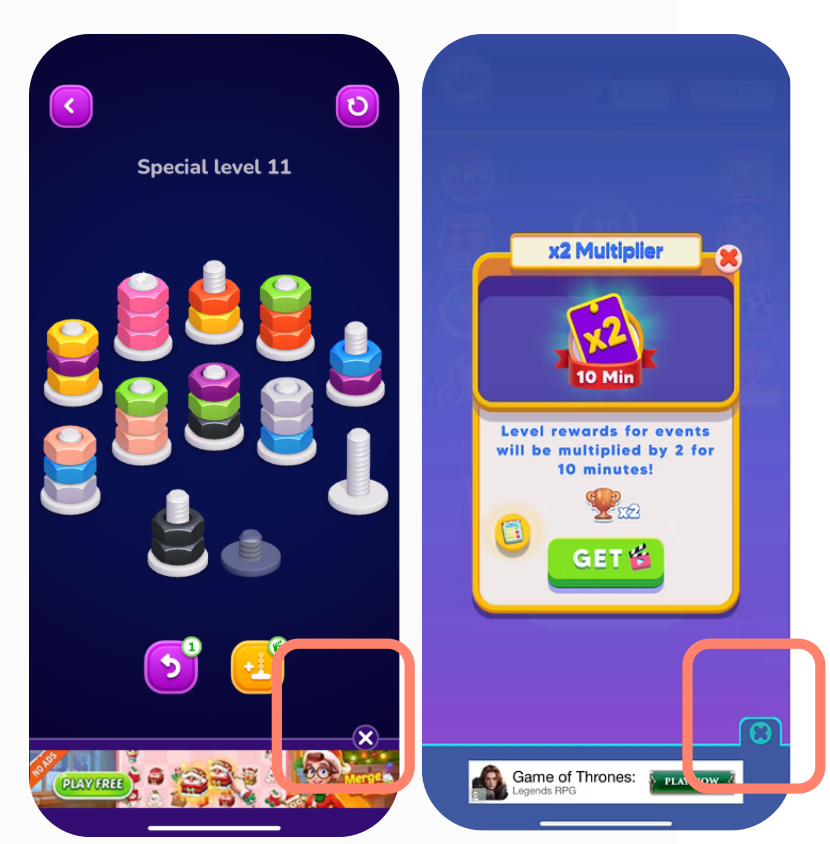
Key risk: tap zones & misclicks
Boosters / core action buttons are often placed at the bottom
If zones are too close, players will misclick the banner when they intended to use boosters → irritation + retention damage (and potentially lower-quality traffic)

Practical tip: Always verify layout across multiple resolutions / aspect ratios. Otherwise you can end up with broken UI where banners overlap key elements (like the 2nd screen – Goods Sort example).
Where to Place Banners?
... and Where Not To?

Most Common Placements:
Gameplay (TOP exposure) – players spend the most time here
Secondary screens – e.g., Settings, sometimes Win screen
Lobby – Usually NO:
conflicts with bottom navigation and high misclick risk
exception: a simple, low-density, flat lobby with clean spacing
Store – Usually NO:
you want full focus on purchases
store visitors already show high intent → don’t distract them
Revive pop-ups – Controversial Depends on your monetization focus:
Hybrid monetization games:
often avoid banners here
focus attention on Continue options (coins / RV)
use the banner Offer Instead
Ads-monetization games (e.g., Block Blast, Cryptogram):
they still keep RV as an option, but maximize ad surface and often place a banner even on Revive screens
Setup Parameters
Same Control Rules as Interstitials
In general, banners should follow similar rules to Interstitials:
When to start showing
Use both gates:
Level reached
Session playtime
And decide whether banners appear:
from session start, or
only after X levels and/or t minutes (early-session protection)
Refreshing banners more often doesn’t always increase revenue.
Too frequent refresh can drop eCPM
It can also increase annoyance → lower loyalty
Plus extra device load (performance, battery, heat), especially on weaker phones
Best practice: test and tune
Creative Cleanup / Blocking
Competitors often run banners with:
fake buttons (CTA imitation)
overly aggressive animations
Track these creatives and block/ban them to protect UX and retention.
Rewarded Video Ad (RV)
Ads are often treated as pure negativity. But Rewarded Video is different: it can HELP the player, not punish them.
The real question is not: 'Where should I place RV?' It’s: 'What player behavior am I buying with this placement?'

Every RV button trains a habit:
Revive, save progress
grind more
get additional rewards
skip friction
or simply keep playing longer
Great RV systems monetize motivation, not desperation. |
Why RV is Helpful for the Players?
RV is useful because it turns a 'paywall moment' into an alternative: instead of paying money/currency, the player can pay with Time + Attention. This strengthens the F2P loop.

What Drives Players to Watch RV?

(1) Habit Pressure: Daily Limits
'I have 2 RV views per day' → I should use them
Creates a routine and planned consumption
(2) FOMO: Missed Value / Opportunity Cost
If I don’t take the RV booster → I progress slowly
If I skip the extra reward → I’m being inefficient
Feels like 'leaving value on the table'
(3) Urgency: Time-Limited
'You have 60 seconds to decide'
Uncertainty about the next chance increases conversion
Scarcity + urgency pushes less rational decisions
RV Visual Standards

(1) Dedicated RV Button Color
Pick one color for all ad-driven actions
Use it consistently across the whole game
Don’t overlap with other button types (IAP / Claim / Continue) Common choices: Yellow (most common) and Purple (less common)
(2) Universal Ad Icon
Use the most recognizable market icon: the clapperboard
Add it to every RV button for instant recognition
(3) 'FREE' Label Works – Even If it’s not 100% True
Yes, the player pays with time + attention
But 'FREE' often increases conversion because the mental comparison becomes:
pay money vs spend time
The most popular RV placements
Revive (Play On)
Revive is one of the TOP monetization points in most games, so it’s also a top RV placement. But it needs strong economic protection.

Don’t devalue coins with Revive Offer different value for Coins vs RV:
Coins = better value (more benefit)
RV = minimum viable help (good, but clearly weaker) This keeps RV available, while keeping Coins attractive.
Protect the economy with repeat-fail logic A strong pattern:
1st fail on the level → allow RV revive
If the player fails the same level again → remove RV, keep Coins only
WHY it works:
Players have already invested effort once
Skipping a 2nd revive feels irrational
Increases coin spend and purchase motivation without inflating rewards Different Value 1st Revive 2nd Revive
Buy Booster
Booster usage is another TOP monetization point.

Common setups:
Different value: Coins vs RV Show clear value gap:
Coins = more (e.g., 3 boosters)
RV = less (e.g., 1 booster) Keeps coins meaningful while still offering RV access.
Same amount for both (the 'player trap')
Offer 1 booster for Coins and 1 booster for RV.
Often seen: different boosters have different coin prices, but the same RV price
As a Result: 30 vs 50 vs 100 = 1 RV
Looks unbalanced – but can be intentional:
Players feel they 'outsmarted the system' by using RV on the most expensive booster
You get what you want: an RV Ad view
Ad Monetization games: RV-only boosters For Ad-monetization focused games:
No coin option at all
Boosters are RV-only, 1-click access, always available High revenue potential, but must be paced to avoid turning gameplay into an ad loop.
Core Gameplay: Extra Shelf

A very effective placement is embedding RV directly into gameplay:
an extra empty slot / extra space on the board (for limited-space mechanics).
WHY it works:
Player can still win without it – but it becomes much easier with the extra slot
You can add it only on Hard / Super Hard levels – with space-deficit situations
The key advantage: it appears before the player loses
the problem is visible
but the negative emotion hasn’t started yet
the player can prevent failure proactively ('one step ahead')
Time Limited Reward: Bulb

This mechanic came from Merge-5, expanded into Merge-2, and is now actively used in expedition games and even casual puzzles.
Core idea:
A bubble appears unexpectedly (ideally at a moment of difficulty): 'Watch an RV to get a reward'
The offer is time-limited (e.g., only ~1 minute)
WHY it converts:
The player doesn’t know when (or if) it will appear again → scarcity
Time pressure pushes less rational decisions → urgency
Extra monetization leverage
If the same booster is normally coins-only, RV feels like a 'freebie' → very high uptake
In Merge-2 this often becomes a classic value comparison:
Fast (hard currency) vs Cheap (RV)
Reward Mult
Unlike scarcity/failure-driven RV, this one is a positive trigger: the player already won – and wants to make the win feel bigger.
2 common implementations
Multiplier 'Tap Meter' (skill/fortune)
Player taps to 'land' on a multiplier
Pros: fun, perceived control
Fixed Multiplier (usually x2)
Simple, fast, predictable
Often more popular today

What to consider
Your multiplied reward must feel meaningful. Players won’t watch an ad for +10 coins if a revive costs 1000.
Best focus: Special Levels
Put the strongest emphasis on Special Levels: Bonus / Hard / Super Hard levels WHY?
Rewards are already higher (sometimes 2-3x baseline)
RV multiplier becomes 'worth it' in the player’s head
Expectation setting: Don’t expect players to multiply every level. With good framing, they’ll use it mainly on high-reward special levels.
Soft Currency income
This placement is especially strong in non-level-based games, where continued play depends on having enough soft currency.

(1) Classic F2P Value Contrast
You offer a clear choice:
Fast / simple / large → IAP or hard currency
Slow / small chunks / 'free' → Rewarded Video ('free' = paid with time + attention)
This is the core F2P principle and it naturally self-segments players: 'Some pay with money, others pay with time'
(2) How to Avoid Breaking the Economy
Key risk: players who would have paid now switch to ads
A common solution: hard cap soft currency from RV (e.g., 4 times/day pattern)
WHY it works:
lets players play longer 'for free'
builds habit + desire to continue
but keeps control over when more aggressive monetization must kick in
Additional placements: Part 1

LiveOps Booster (x2 / x3)
Works both ways: if a player enters an event, they’re more likely to activate a booster.
If they activate a booster, they’re more likely to keep playing the event until it expires (to 'use it fully').
Lives
Common tradeoff: refill +5 Lives pack for coins VS +1 Life for RV
RV helps soften friction without fully removing the sink
Pre-Level Booster
Provides a 'helper' for the upcoming level via a booster
Works best right before Hard levels: frame it as a 'support' to beat a difficult stage
Additional placements: Part 2

Core Mechanics Help
Pay RV to unlock a feature temporarily (e.g., open a shelf early)
Place it where valuable resources are visible → clear perceived value
Wheel of Fortune
An extra resource source
Best surfaced at session start so players don’t forget it
Daily Calendar Quest
Catch-up If a player missed a day → replay it via RV
Supports retention (daily habit) + recovery for missed days
Additional placements: Part 3

Ad Endless Offer (RV-only)
Increasing rewards in the chain
Few users max it, but many take 1-2 steps/day → great at scale
Daily Shop Bonus
Drives traffic into the store
Should feel meaningfully valuable (otherwise ignored)
Extra Reward on Top (Bonus for RV)
Not watching feels like missing out
Position it as 'bonus' rather than 'required'
NoAds
WHY do you need it?
Whenever we create friction in a game, it’s smart to design the solution at the same time:
Low on coins → offer a deal
Falling behind in a tournament → offer a booster
Same logic applies to ads. Annoyed by ads? → offer No Ads.
For the player: a clear way to pay for comfort and remove interruptions
For the game: a direct way to compensate the revenue you would’ve earned from ads

It’s also important to clarify what 'No Ads' usually means:
Remove the annoying ads: Interstitials + Banners
Keep the useful, player-beneficial ads: Rewarded Video (RV)
NoAds: BUT, Is It Always Worth It?
Many teams treat No Ads as the default. But it’s not always the best business decision.
Block Blast example (Hungry Studio) Block Blast runs all Ad formats, yet players report NO option to pay to Remove Ads. So yes – a top game can exist without No Ads.

WHY might 'No Ads' be worse for revenue?
No Ads is basically Ad Revenue ‘compensation’:
you trade ongoing ad impressions for a one-time (or limited) purchase.
In some games (high engagement / long sessions), the ad revenue from an active player can exceed what No Ads would bring – especially if:
Retention + Playtime are strong
Interstitial pressure is softened (e.g., longer gaps between interstitials in Classic Mode)
Self-check question: Have you modeled this for YOUR game?
|
No Ads: Temporary or Permanent?

Most games sell No Ads forever
However, you can experiment with time-limited No Ads (just make sure you reserve enough time to run a proper test)

Interesting uses of Temporary No Ads:
Event reward: let players taste the game without ads – when ads return, they’re more willing to pay to get that comfort back.
Welcome Back reward: remove ad pressure right after a return, reducing the risk of a quick churn on return.
How to Sell No Ads: The 'No Ads Offer'
A common best practice is to create a dedicated NoAds Offer.
Compared to hiding No Ads in the Shop, it has clear advantages:
A lobby widget (sometimes even visible in core screens) → always reminds the player
A session-start pop-up, plus extra triggers (e.g., right after an Interstitial) → unlike the Shop version, where the player must remember to go find it

Typical offer structure
Most often it’s a Bundle: No Ads + extra currency/resources
More rarely (not necessarily worse): No Ads only Both options (No Ads only + Bundle) shown side-by-side
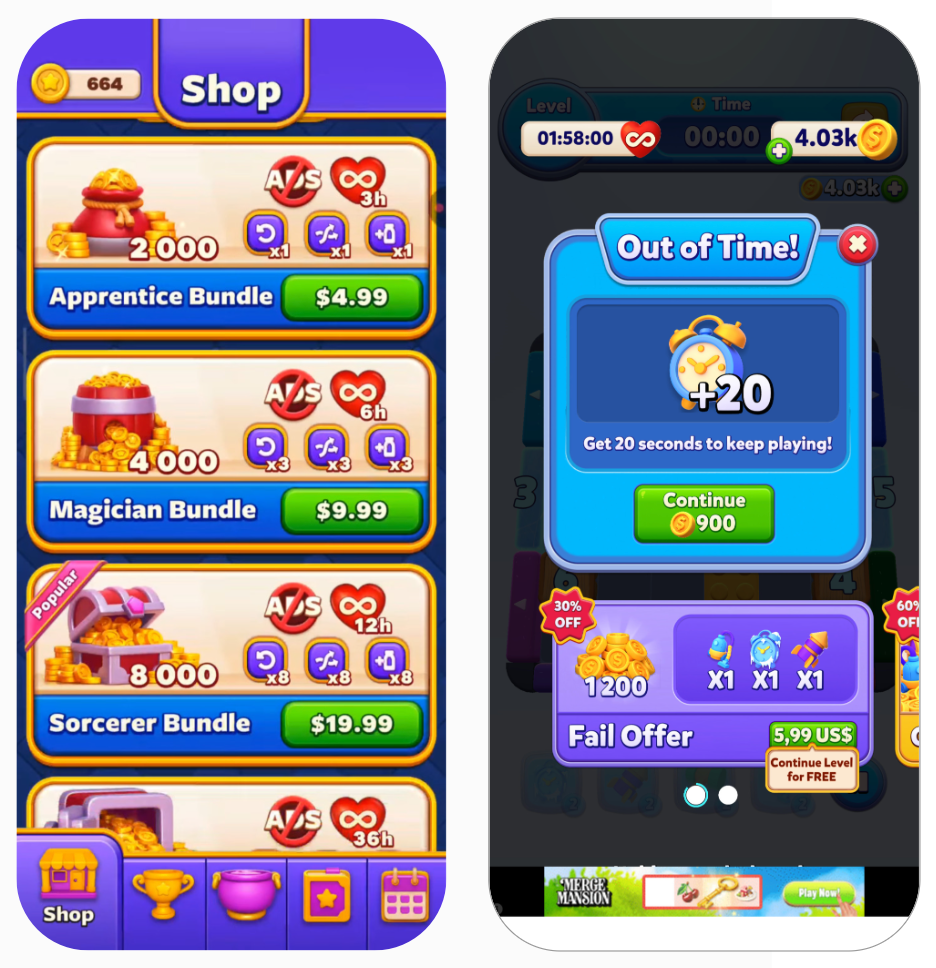
How to Sell No Ads:Shop NoAds Bundles
'Just No Ads' + 'No Ads Bundle' (Side-by-Side)
Place two offers next to each other:
Option A: No Ads only
Option B: No Ads + extra currency/resources
Often the bundle is visually larger → stronger attention pull
Make No Ads offers stand out from the rest – use distinct color, animation, and visual treatment to separate them from standard shop items.

WHY it works:
Anchoring effect: value of the bundle is much higher, while price is only slightly higher
Pushes players toward the bundle as the 'smart choice'
How to Sell No Ads: with ANY Purchase
When is this setup is especially good?

If your game is IAP-focused, it can be smarter to:
earn less from No Ads,
but protect Payer Retention and reduce churn risk.
Extra control lever:
Gate No Ads behind a minimum price tier (e.g., No Ads included only in purchases $6.99+, not in the cheapest offers)
This keeps high-value bundles attractive:
If a player is ready to spend $30 → they buy the $30 bundle and get boosters + No Ads
Otherwise they must choose: Best Value bundle vs No Ads (best case: they buy both over time)
Self-check metrics (to validate your setup)
|
How to Sell No Ads: Extra Examples
'Close' Button on the Banner
Player expects to close the banner, but tapping the Close Button → opens a No Ads offer instead.
'Disable Ads' Toggle
A toggle placed in core gameplay or Settings (alongside other toggles) that naturally leads into the No Ads purchase flow.
Core Gameplay Icon Useful when players rarely return to the lobby – keeps No Ads always accessible.

Choosing Ad Strategy by Monetization Type
Ad Monetization Focus:Interstitial Ad
'Meditative' / Low-Fail Games → Interstitial-driven
When gameplay is relaxing and it’s hard to lose, Interstitials often generate the majority of Ad Revenue.

What matters most:
Higher Retention + Playtime = higher revenue
Session limiters are often removed (lives / energy)
Level pacing supports more ad opportunities:
short levels → more end-of-level inter triggers or
long levels → higher engagement, but with ad breaks
Interstitials + banners can start earlier (after initial engagement gates)
Ad Monetization Focus:Rewarded Video
If the core has real challenge, RV becomes the main monetization tool.

Key design question: Do you need soft currency (coins) at all?
Coins can:
create an IAP bridge
but also add friction, fake value, and unnecessary choice layers
In ads-first games, a cleaner approach is often:
Failed level? → +5 moves for RV
Hard level? → RV booster
Direct, one-click RV – instead of 'coins vs ad' comparisons
RV Reward Size: How Much Do You Give? A key tuning question: what’s the RV payout?
1 booster → drives more frequent RV views
2+ boosters → increases the chance the player keeps playing (because they feel 'powered up')
How to decide:
|
Hybrid IAP-focused Monetization
(1) Interstitials + Banners
In long-run IAP projects, you can skip Inter + Banner entirely
If you still add them: start later than usual and use longer cooldowns
(2) No Ads
Best fit: 'No Ads with ANY purchase' Once a player buys anything, they’ve 'opted out' of annoying ads.
(3) Rewarded Video (RV)
Often remove RV from core monetization points:
Revive / Continue
Booster purchase moments
Use RV for controlled currency inflow instead:
mini-games / periodic bonuses
but limit it (X times per day)
Goal: Keep coins valuable vs ads
Hybrid Monetization
Wherever you have a coin sink, you can often add an RV placement as an alternative path.
When Coins and RV are side by side, use anchoring to highlight the option you want to be the 'optimal' choice.

For hybrid monetization, segmentation is a must:
Treat payers like an IAP-first audience (with lower ad pressure)
Treat highly engaged non-payers more aggressively with ads
And keep testing continuously:
Coin value next to ads (does RV devalue coins?)
RV presence on monetization moments (does it cannibalize purchases?)
Ad pressure tuning: unlock points, cooldowns, overall aggressiveness
Same Genre - Different Monetization: Screw Jam example

Screw Jam (early pioneer)
IAP-focused monetization
Almost no RV placements (mostly: Wheel of Fortune, +1 life)
Mid-length levels, high variability, relatively high difficulty
Next wave: Screw Pin / Screwdom / etc
Same core loop (almost 1:1)
Hybrid monetization
Often no Interstitials, but RV covers most monetization moments
Slightly easier level design (still with challenge)
Clones didn’t win by 'better core' – they won by monetization accessibility
RV-heavy coverage can outperform IAP-first setups when:
difficulty creates frequent 'help' moments
RV is placed as a solution (revive, boosters, extra moves)
pressure is tuned to avoid churn (cooldowns, pacing)
Key idea: Same gameplay + different monetization architecture = different ceiling.
Same Genre - Different Monetization: Magic Sort example
Nut Sort (earlier wave)
Very easy levels, minimal challenge
Very short levels (fast clears)
Ads-first monetization: no coins, lots of Interstitials
Magic Sort (opposite strategy)
Harder levels with more non-deterministic mechanics (built-in challenge)
No revive, no RV boosters (no 'ad-based help')
Result: they significantly outperformed Nut Sort

Key takeaway:
More ads ≠ better results.
Sometimes stronger core challenge + clean experience scales better than aggressive ad pressure.
Segmentation
Segmentation Parameters (What to Segment By)
(1) Acquisition
UA type (Ad-, Blended-, IAPROAS)
Source / network / campaign
Country / region (different eCPM + different ad tolerance)
(2) User Behavioral (Engagement)
Lifetime (days since install)
Level progress
Playtime / session length
(3) User Behavioral (Monetization)
Payer vs Non-payer
Whale vs One-time buyer
Recency: how long since last purchase
Strategy note: For payers, it’s often better to earn less from ads but win on retention + future IAP. Also, payer segments often have higher eCPM, so lighter ad pressure doesn’t always mean proportional revenue loss. |
What Should You Segment in an Ad System?
People often say: 'Whales should have no ads.' But a more flexible approach is to keep ads for everyone – just dose them.
How to do it:
Set a daily total cap on ad impressions
Set per-placement caps (e.g., limit Revive RV separately from bonus RV)
Add cooldowns between ad views to avoid back-to-back pressure
This approach can also help build a habit: when ads are limited and predictable, players tend to 'use their daily views' intentionally instead of feeling spammed.
Interstitials
Start conditions: Level X + Playtime Y
Pressure control via Сooldowns (especially for payers)
every N levels
time since last Inter time since last RV
Rewarded Video (RV)
Limits + cooldowns (per session / per day)
Enable/disable specific RV placements turn off RV on monetization moments to protect IAP keep RV for 'support' / periodic income
Banners
Enable/disable by segment
Start conditions: Level X + Playtime Y
Refresh rate
Extra Notes
Interstitial Instead of RV (On Reward Placements)
Sometimes you can replace a Rewarded placement with an Interstitial.
Why it can work:
Higher eCPM: Interstitials may monetize better than RV (or roughly the same) in some cases.
Lower Churn: because the ad is shorter, there’s less interruption – and a lower risk the player quits during the ad. Keeps the player in the flow, especially in high-frequency reward taps (boosters, small bonuses)
Key idea: Optimize not only revenue per view, but also revenue per retained player. |
Ad Creative Filtering (Protect UX & Retention)
Not all ads are equal. Some creatives actively damage your game experience – and your metrics.

What to filter out
Annoying / misleading creatives Overly aggressive, intrusive, or deceptive interactions
'Gross' creatives Pimple popping, dirt/cleaning – anything that can disgust players.
Political or highly triggering topics
Polarizing content that can create negativity and complaints unrelated to your game.
Too bright / attention-stealing ads Especially banners with neon / acidic visuals and 'screaming' CTA buttons – they hijack attention and feel toxic inside a calm UI
Direct competitors Yes, they often have high eCPM – but they also raise churn risk by pulling players into similar games with stronger hooks.
Key idea: Creative filtering is not 'nice to have'. It’s a retention safety system: remove the ads that monetize today but lose players tomorrow. |


Comments