


How to Prepare Your LiveOps for the Holiday Season

We’re entering the Holiday Season – Christmas, New Year – the weeks when players come back, spend more time in the game, and are naturally more open to rewards and special events.
It’s also the moment when teams wrap up the year, review what worked (and what didn’t), and look for growth levers before Q4 closes. And LiveOps is one of the few levers that can still move the needle effectively
But here’s the key idea: LiveOps shouldn’t be a holiday trick. It should be a system. Seasonal events only Amplify a Foundation that already works.
This guide breaks down how TOP Games structure LiveOps, what’s NEW this Season, and how to build a scalable system that performs during Holidays

Why the Holiday Season Deserves Special Attention
Major holidays are always worth extra attention – they bring more than just festive decorations.
People are in a better mood, surrounded by a special atmosphere, and most importantly – they have more free time. For many, this is also the season of year-end bonuses and gift spending
→ This combination naturally drives stronger Engagement and higher Spending
As seen below, Top titles that planned their systems strategically – achieved Revenue uplifts from 16% to 45% during this period.

You can also look beyond Christmas – there are a few other major holidays worth paying attention to.One of the key ones is the Thanksgiving – Black Friday period (28-29 Nov, 2024), which often acts as the kick-off to the festive season.
Together with Playliner, after analyzing hundreds of games, we saw a clear trend: - Nearly all of them show Revenue growth between 15% and 50% during this window.

Another key holiday to keep in mind is The 4th of July: Independence Day in the USA.
This holiday perfectly breaks up the Summer Season, giving companies a strong reason to re-engage players.

Together with Playliner, we analyzed: hundreds of Games and thousands of Events launches across different types and genres. We discovered multiple patterns and correlations – and compiled the Best Practices and Insights to help you build a strong LiveOps System and adapt it to the Holiday mood and festive vibes. |
Add the Holiday Spirit
1. Start Celebrating Early
Christmas officially falls on December 24, but don’t wait until then to celebrate. Start building that ‘Holiday Mood’ in early December – right after Thanksgiving and Black Friday.

What does this mean for you? It means planning should start way earlier – ideally in August or early September. And no, that’s not a joke, it’s how Top teams actually do it.
2. Set the mood
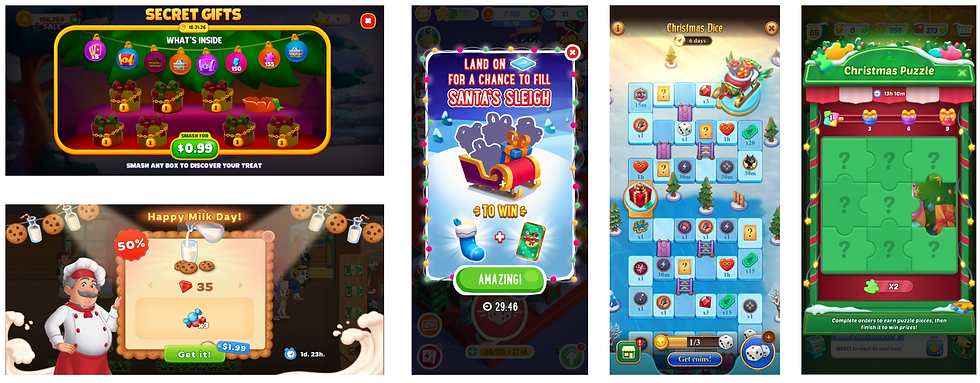
Give your top events a festive reskin – Christmas versions always feel special.
Respect your audience’s traditions. And don’t mix them up:
Stockings, fireplaces, milk and cookies for Santa belong to Christmas
While disco balls, champagne, and midnight kisses belong to New Year’s Eve

Decorate the Christmas Tree / Decorate the Location
Decorating a Christmas tree is one of the most recognizable and beloved traditions – and many games borrow this metaphor to instantly create a festive, cozy atmosphere.
Another variation is Location Decoration – where players gradually add new festive details to their town, yard, or room, watching it come alive with every completed milestone.

Advent Calendar / 12 Days of Christmas
Whether it’s a classic Advent Calendar or a “12 Days of Christmas” countdown, the idea is the same: create a daily ritual that keeps players excited to come back – and rewards consistency with growing value.
Lifehack: Your “gift” doesn’t always have to be a reward – it can also be a Bonus on Purchase (like a special discount or bundle) or even the Launch of a new Event.

Other Classic Decoration
And of course, you can weave other Christmas traditions right into your existing events.They don’t need to become standalone features – just small thematic touches that add charm and familiarity:
Gingerbread cookies
Letters to Santa
Santa’s Workshop
Milk & Cookies for Santa
Christmas decorations, red-and-white candy canes, and more
3. Don’t forget about your App Icon
Have you ever seen your DAU spike unexpectedly after a release – even without major changes inside the game?It often happens right after an App icon refresh. A festive icon on the home screen catches attention and subtly reminds your existing audience to come back.
So, don’t skip this step – give your icon a seasonal touch and let it work as a small, silent reactivation tool

Building Your LiveOps System
The LiveOps landscape can be grouped into 3 main layers:
Global Events (Long-Term) – the overarching structures, seasonal or always-on, that hold everything together
Complex Events (Mid-Term) – system-level events that reinforce and connect other activities
Basic Events (Short-Term) – engagement loops built around milestones, mini-goals or streaks

Simple Basic Events (Short-Term)
These events typically serve as the starting point for most LiveOps systems:

Main Characteristics:
Short in duration - usually 1-3 days
Focused on Short - and Mid-term Goals
Core principle: Play the main loop → Progress the event
Typically use a soft difficulty curve (easy start → harder finish, with ‘sawtooth' pacing)
Built around frequent milestones so players hit several milestones within a single session
Work best when progress is visible and supported by 'almost there' nudges
Ideally use asynchronous progress, so reaching a milestone in one event already partially fills the next
They can be presented in different thematic wrappers:
Milestone Progression
Win Streak
Competition
Mini-Games
Milestone Progression
The simplest and most intuitive type of event – a sequence of milestones, each with a reward. 'Simple' DOESN’T mean 'Weak'. When tuned correctly, this format is extremely effective.

A few hidden gems:
Re-skin + re-frame often The same event can feel fresh when the visual part changes. For example, the core mechanic across the 1-3 screenshots is identical – yet each event feels different thanks to theme and presentation.
Great as a 'currency feeder' into other events. Instead of paying out core currency, you can reward tokens for another event. This builds natural events synergy (like in the 4th-5th examples in the screenshot)
Use a difficulty 'sawtooth', not a straight line – to create natural ‘rest’ moments between difficulty spikes. Start easy → ramp up → drop → ramp again (e.g. 60 → 200 → 80 → 250)
Choose your Event Difficulty curve wisely: for example Linear or Exponential saw patterns both work well, depending on your genre, audience, and how segmented your event experience is

Reward with timed boosters/livesThis creates a self-sustaining loop: progress → reward → longer session → more progress → next reward.Royal Match uses this heavily – roughly every 2nd or 3rd reward is a Time-Limited benefit, designed exactly for this purpose.

Win Streak
If your game uses a Level-based progression → Win streaks are a must – they boost both Engagement and Monetization.

Tune milestone frequency to your difficulty curve If your game has a 'Hard Level’ every ~5 stages, then a 4-step streak will feel easy – but an 8-14 step streak will require real effort and drive much higher commitment

Always communicate ‘Streak loss’ clearly.
In Royal Match, progress visibility is crystal clear – the player always knows exactly how far they’ve come: ex. 4/5 levels – losing progress feels tangible and painful
In Disney Solitaire, the visual feedback is unclear – whether it’s 2/15 or 14/15 – the rainbow looks the same. This misses a key psychological trigger, since nearing completion naturally drives stronger motivation to keep going

New Interpretation of the Lava Quest

This format has already become a player favorite – and recently it has evolved even further.
What’s new in the latest versions:
The event now has 3 stages, each one harder than the previous.As players progress → the commitment to finish keeps growing
The social component is removed – instead, the final reward is a Picking mini-game with 1-of-3 prizes.Similar to Monopoly Go’s style: Less predictability → more Excitement, Gambling feel
Along the way, players also collect card packs, which creates an extra 'pull forward' through collection synergy
What if your game is NOT Level-based?

Travel Town and Gossip Harbor show a great workaround for non-level systems.
The Core idea stays the same – step-by-step progression + competition with other players
But instead of levels, the event uses Special Event Quests as the source of progress
The integration is less 'native' or intuitive than in Level-based games
However, event quests still allow you to build a difficulty curve and even personalize progression per player
Competition Mechanics
Tournaments are a powerful motivator because they add Social Comparison on top of personal goals. The player is no longer progressing 'for themselves only' – they’re competing against others, which multiplies Engagement.
There are 3 common formats:
Classic Tournaments – leaderboard by collected points
Race – first to finish + reach a target
Duels – 1v1 or small pool direct competition

Classic Tournaments
A classic format: players earn points through core activity, and rewards are granted at the end based on final placement.

Hidden Gems:
Add Personal Milestone Progression. Since tournaments are long and rewards arrive only at the end, milestones provide positive reinforcement and more frequent touchpoints with the feature
Poor interaction flow has killed many otherwise great LiveOps systems
Use Multipliers to Boost Monetization. Players always earn points, but maintaining a streak multiplies their reward – and clearly showing this in the Lose pop-up amplifies the emotional (and spending) pressure.
Race Tournament

More Dynamic and Session-driven – goals are usually sized to be completed within a single play session or even less. If your goal is to extend play sessions, this tournament format is a perfect fit

Duels (1х1 Tournament)

Duels focus the player on Direct, Head-to-head Competition – maximum attention on the opponent.
Strong emotional payoff due to Personal rivalry
Easy to expand into a Multi-stage experience: win one Duel → instantly advance to the next.
Each stage can either maintain the same target for consistency or escalate — with tougher objectives, or stronger opponents – creating a natural sense of rising challenge and momentum.
Mini-Games

The category speaks for itself – these events are built around a light gameplay break using familiar or trending mechanics.
Often based on nostalgic mechanics (like Zuma), current hits (Block puzzles), or chance-based formats where players can 'try their luck'
These events stand out because they “Let players PLAY, not just fill a Progress bar”They add moments of real gameplay and interaction — quick sessions where players make choices, test their luck, and get instant feedback.
It’s a reminder that even within LiveOps, players crave play, not just progress.
Complex Events (Mid-Term)

This next category is more Systematic and goes beyond 'Play the core → Earn progress.'
What makes them different:
They usually require Multiple Layers of Activity, not just core gameplay – e.g. completing special quests, interacting with other events, or triggering meta-features.
They run much longer – typically 5-14 days, which allows for build-up, Anticipation, and deeper Engagement loops.
They often act as a Hub that connects smaller events into a bigger experience.
Let’s break down their structure and what makes them effective.
Battle Pass

Battle Pass deserves a separate full breakdown – but here’s the core idea in a nutshell.
The strength of the Battle Pass is that it works in both directions – as an Engagement driver and a Monetization driver:
If a player buys the pass → they feel motivated to play more to 'get full value'
If a player plays a lot → they are more likely to buy, because they already see how many rewards they are unlocking
The most important decision is HOW Players Earn Progress. There are 3 common models:
Special event Quests (ex. Coin Master, Candy Crush Soda Saga)
Less common for Puzzle games, but popular in other genres
Typically seen in games that rely on simpler Daily Challenges or have fewer Event types focused on diverse mission structures.
In such ecosystems, special quests help add variety and depth to the overall LiveOps cycle.
Passive filling from Core Activity (most of the market, includes Royal Match, Travel Town)
The classic and simplest approach – progress fills naturally from playing the core loop.
Most common in Puzzle and Hybrid-casual audiences, where clarity and smooth flow matter more than variety.
Achievement-style Quests – one mission type with multiple targets, all progressing at once (ex. Gossip Harbor)
One mission type – multiple goals, all filling up simultaneously.This format isn’t limited to Battle Passes – you’ll see it in:
Daily Challenges (Travel Town)
Offer Challenges (Match Factory)
Weekly Events (Royal Match)
Games usually apply this type of currency accumulation to only 1 event at a time.
Overlapping multiple events with the same mechanic tends to confuse players and dilute the purpose of each, making the system lose its meaning.
Social Events (Cooperation)

This type of event is a great fit for large, even mature projects. All socially-driven features are primarily a Long-term Retention tool.
The player progresses together with teammates. Without a full group, you simply can’t win – Radical, but very effective
Social responsibility kicks in: when others contribute, you don’t want to become 'the weak link'

Choose rewards that signal prestige.
If your players are motivated by social interaction and recognition, use it not only as a mechanic but also as a reward – unique avatars, frames, or badges they can proudly display in leaderboards, tournaments, or clan spaces. Something that clearly says: “I’m special, I’m unique – I earned this”
Weekly Quests
This feature is designed to keep players active for Several Consecutive Days – every new day pulls them deeper into the loop.

How it works:
Progress is Cumulative across ALL days/stages – from the very start of the event
But you can start collecting tomorrow’s rewards only after fully clearing today’s stage / at the beginning of the next day
The quests don’t just make the player play – they make them Participate in other Events, which multiplies activity across the whole LiveOps system
A great example is Royal Match: by completing today’s tasks → the player is already 50%+ through tomorrow’s progress, which makes it very hard to drop out
Additional Mode

These events are essentially 'a Game inside the Game' – they feel big enough to qualify as a secondary Core Loop.There are 2 main approaches:
Modified version of the existing core – typical for Merge games and Hidden Objects
A completely different core – Coin Master, Homescapes – new gameplay format layered on top of the main one
The tradeoff is development cost. This format is usually used by: mature projects, with a polished and stable LiveOps system, where adding new revenue sources is harder within the existing loops. So, If your game is still early or mid-stage – think twice before committing to this kind of event.
Complex Events

The key characteristic of this type of event is that Currency is Earned from multiple types of Activities:
from the Core Gameplay (e.g. levels, daily quests)
and from other Events running in parallel
Because progress is sourced from different parts of the game, the event feels systematic, not isolated – it connects mechanics together and turns LiveOps into a broader game-wide experience.
Example 1: Disney Solitaire

Let’s look at how different event groups source their currencies:
Group 1 (Short-Term) – the player earns currency ONLY through Core Activity (=Level completion)
Group 2 (Mid-Term) – the player can either buy it in Offers or earn it from other Events (Group 1 or 2)
Group 3 (Long-Term) – currency can be purchased in Offers or collected from any Events (Groups 1, 2, or 3)
Events in Group 3 DON’T reward currencies for lower-tier events (Groups 1 or 2). Instead, they either grant Currencies for other Group 3 Events or reward only in-Game Currencies
Example 2: Royal Kingdom

A similar setup can be seen in Royal Kingdom – the player collects currency from various tournaments and events to use it in a Social Event.
They can also earn a small amount of that currency from regular level completion, but it’s much lower compared to what they gain through other events.
Collections: Albums (Long-Term)

Collections are the final touch – a large-scale event that ties all other activities into one cohesive system.
Long-term format – usually running for 1.5-2 months.Some wonder – Whether to make it Permanent or Seasonal?For your information: both Royal Match and Coin Master used to have Permanent albums but later switched to Limited-Time Collections - and there are many reasons why this was a smart, Monetization-friendly move.
Card sources: EVERY part of the Game – Core, Features, Events, Purchases, Offers, even Social mechanics.That’s why, if you already have a strong LiveOps system, a Collection is a perfect next step.
Main Mechanic = Gacha. One of the most exciting and universally loved mechanics. You know that feeling of opening your 5th pack, still hoping for that one missing card – pure gambling
Motivation: Collecting.Many of us are completionists at heart – we love organizing, sorting, and completing sets.
Leverage Social play. Let players Request and Trade Cards with friends – it builds engagement far beyond the event itself.A strong Community layer around collections turns a simple feature into a shared experience.

Balance Cards and Packs Rarity wisely. A safe reward for your economy. When balanced properly ...
Want the full breakdown?Read and Download the Full Report – on Sensor Tower: Why you don’t want to miss the Full Report?
|


Comments